

Top 5 Wood Cores for Bsmart Wall-Integrated Furniture
Between Vietnam’s hot and humid climate, with its persistent dampness and prolonged rainy season, makes built-in wardrobes prone to blistering, warping, and even unpleasant musty odors. Few realize that hidden beneath that glossy surface is a solid wood core – the “backbone” that determines longevity and peace of mind during use. WithBsmart Wall-Integrated Furniture, choosing moisture-resistant wood cores is not only a technical solution but also a commitment to durability, health, and long-term value. Join us as we explore the top 5 best moisture-resistant wood cores, where materials become the foundation for a sustainable space.
1. Structure and criteria for evaluating the moisture resistance of wood core

What is wood core in the production of Bsmart Wall-Integrated Furniture
In the world of built-in furniture, the wood core is the hidden core. Determining the overall “health” and lifespan of the product. While surfaces like melamine, laminate, or acrylic are the aesthetic coating. The wood core is the load-bearing framework, supporting all environmental impacts, loads and the passage of time. The entire load-bearing capacity, screw fastening, hinge and drawer connection, and the sturdiness of the cabinet doors. All depend directly on the quality of the wood core.
Structurally, wood core is formed from base materials such as wood fibers, wood chips, or finely ground natural wood. Combined with adhesive and technical additives. This blend is what creates the differences between various types of wood core: from MDF, HDF, and Plywood to high-end moisture-resistant boards. The adhesive not only serves the purpose of bonding. But also directly affects moisture resistance, stability, and health safety. Meanwhile, moisture-resistant and termite-resistant additives help the wood core adapt better to the hot and humid climate typical of Vietnam.
For built-in furniture, especially built-in wardrobes that fit snugly against the wall, there are few gaps and they are almost impossible to replace. The wood core is not simply a material, but the foundation that determines the durability of the entire interior design project.
>> See more: Top 6 Bsmart kitchen cabinet models worth owning.
How does the structure affect its moisture resistance?
The moisture resistance of wood core doesn’t come from a single factor, but rather the combined result of many structural components and manufacturing processes. First and foremost is the size of the wood particles or fibers. Wood cores using fine, evenly distributed fibers will have tighter bonding, limiting capillary gaps – the pathways through which moisture penetrates and causes swelling. Conversely, coarse, unevenly sized wood chips easily create voids, causing the board to absorb moisture quickly and deform significantly.
Choosing the right type of adhesive is crucial. UF (Urea Formaldehyde) adhesive is low-cost but has poor moisture resistance. Bonds easily degrade in humid environments. Meanwhile, MUF (Melamine Urea Formaldehyde) adhesive significantly improves moisture resistance and is often used for green core moisture-resistant boards. A higher-grade option is Phenolic adhesive, known for its water resistance and long-term stability. It is commonly found in high-quality engineered wood panels.
The density of the wood core (kg/m³) also determines its moisture resistance. The higher the density, the denser the structure. This reduces water absorption and improves stability. In addition, the amount of moisture-resistant additives and the precise hot and cold pressing process help the glue penetrate deeply and create strong bonds. This results in a board that can withstand moisture for a long time, not just provide temporary water resistance.
Criteria for evaluating good moisture-resistant wood core for Bsmart Wall-Integrated Furniture
To assess whether a wood core is truly suitable for built-in furniture in Vietnam’s climate, one needs to look beyond the advertised surface and focus on core technical indicators. First is the swelling rate when soaked in water – a parameter reflecting the degree of deformation of the board when exposed to moisture. High-quality wood core will have a low swelling rate, maintaining its shape even under constantly changing environmental conditions.
More importantly, it needs to withstand prolonged exposure to moisture. Some types of wood panels may be water-resistant for a short period, but they gradually weaken when placed in a humid environment for extended periods. This is a common problem in Vietnam. Good quality wood core must maintain its structural integrity, not rot, and not delaminate over time.
Shape stability is a key factor. Built-in furniture requires high flatness and perpendicularity. This ensures the entire system operates smoothly, synchronously, and accurately throughout its lifespan, preventing warping, misalignment, or accumulated errors over time. The ability to connect, bear loads, and maintain structural stability must also be ensured, especially for systems with significant height or those permanently fixed to walls or ceilings. Finally, health and safety are non-negotiable criteria. Emission standards such as E1, E0, and CARB-P2 help maintain a clean and safe living environment for families, aligning with Bsmart’s philosophy in every built-in furniture solution.
2. 5 types of moisture-resistant wood core for Bsmart Wall-Integrated Furniture
Moisture-resistant plywood core in Bsmart Wall-Integrated Furniture
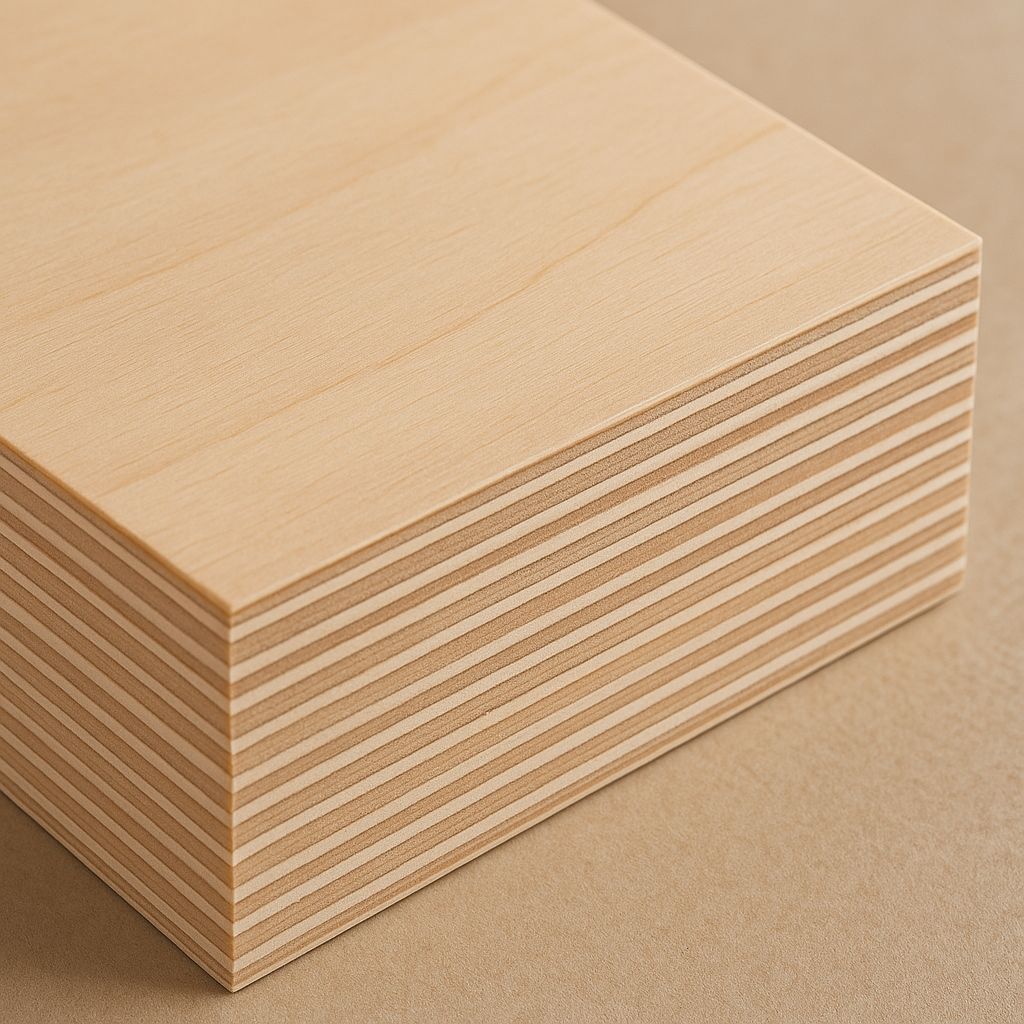
Moisture-resistant plywood, also known as multi-layered plywood, is considered a steel shield in the world of built-in furniture, especially when facing the harsh humid climate of Vietnam. Structurally, plywood is made from many thin layers of natural wood veneer, stacked and pressed diagonally at a 90-degree angle. This diagonal pressing principle almost completely eliminates shrinkage and warping along the wood grain.
The inherent weakness of solid natural wood is its veneer layers, which are bonded together with phenolic or MUF glue. Plywood is renowned for its moisture resistance, heat resistance, and long-lasting bond strength. Common thicknesses range from 12mm to 18mm. This allows plywood to achieve an ideal balance between strength and versatility in wall and wall applications.
The most outstanding advantage of plywood core lies in its superior moisture resistance
Thanks to its tightly pressed multi-layered structure and water-resistant adhesive, plywood minimizes swelling and delamination when exposed to moisture for extended periods. Furthermore, plywood boasts exceptional load-bearing capacity, allowing for the installation of large door panels and heavy-duty rail systems without sagging or deformation over time. Its screw-holding ability is also particularly strong; screws penetrate deep and hold securely within the veneer structure, providing a solid and reassuring feel during use. Therefore, plywood is considered an ideal choice for areas close to walls with limited ventilation, where moisture is always present.
The disadvantages of plywood core for Bsmart Wall-Integrated Furniture
However, high quality always comes with a cost. Moisture-resistant plywood is significantly more expensive than regular MDF or MFC. Its heavy weight also makes installation more demanding, requiring more precise techniques and labor. The quality of plywood also largely depends on the veneer source and the type of adhesive used. Poor quality veneer or substandard adhesive can significantly reduce overall durability.
At Bsmart, plywood is often preferred for the “backbone” components of built-in furniture, such as floor-to-ceiling built-in wardrobes, base kitchen cabinets, floor-to-ceiling shoe cabinets, and load-bearing decorative wall panels. These are areas requiring high stability, durable moisture resistance, and a long lifespan. This is where plywood fully demonstrates its value as a high-class, reliable material for Vietnamese living spaces.
Bsmart Wall-Integrated Furniture – Moisture-resistant green core MDF wood
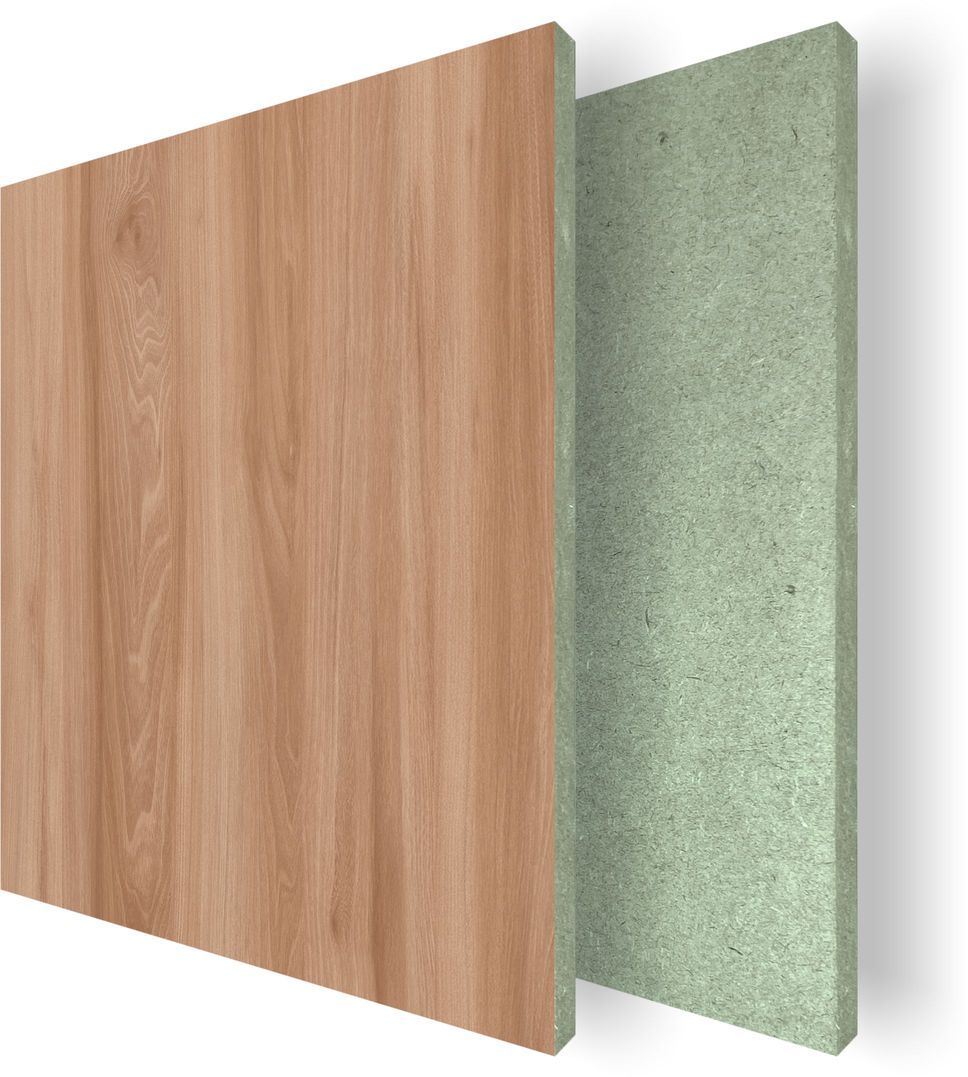
Moisture-resistant green core MDF is considered the perfect balance between aesthetics, moisture resistance, and cost-effectiveness in the modern built-in furniture segment. Essentially, green core MDF is made from finely ground and evenly distributed wood fibers, then pressed at a high density, typically 720 kg/m³ or more. The key difference lies in the specialized moisture-resistant adhesive, usually MUF glue, combined with technical additives. This creates the characteristic green color inside the core of the board. This core layer significantly improves moisture resistance compared to regular MDF, especially in hot, humid climates and prolonged dampness.
In terms of advantages, green core MDF has approximately 30-40% higher moisture resistance compared to standard MDF. This is sufficient to meet the needs of interior environments with a mix of dry and humid conditions. Thanks to its fine and uniform fiber structure, the board achieves high flatness, a smooth and stable surface. This provides an ideal base for finishes such as melamine, laminate, or acrylic, ensuring good adhesion, even color, and long-lasting beauty.
This not only provides high aesthetic appeal but also makes the surface scratch-resistant, easy to clean, and maintains its beauty over time. Another major advantage of green core MDF is its reasonable price, making it more accessible than plywood, while still ensuring the necessary durability and stability for built-in furniture.
Limitations of green core MDF
However, green core MDF also has certain limitations. Despite its good moisture resistance, this type of wood core is not designed to withstand prolonged water submersion. When exposed to water for extended periods, the board still risks swelling and weakening of the bonds. Furthermore, green core MDF has lower load-bearing capacity and screw-holding ability compared to plywood, especially for applications requiring large door frames or high loads. Careful planning is necessary during design and construction.
At Bsmart, moisture-resistant green core MDF is widely used for items such as built-in wardrobes, display cabinets, and wall-mounted TV cabinets. These are areas requiring high aesthetics and a smooth, beautiful surface without excessive load-bearing capacity. This is also a popular solution for apartment living, where a balance between durability, functionality, and budget is needed, while still ensuring a sophisticated and sustainable living space over time.
Moisture-resistant HDF core – The core material for durable, long-lasting built-in furniture
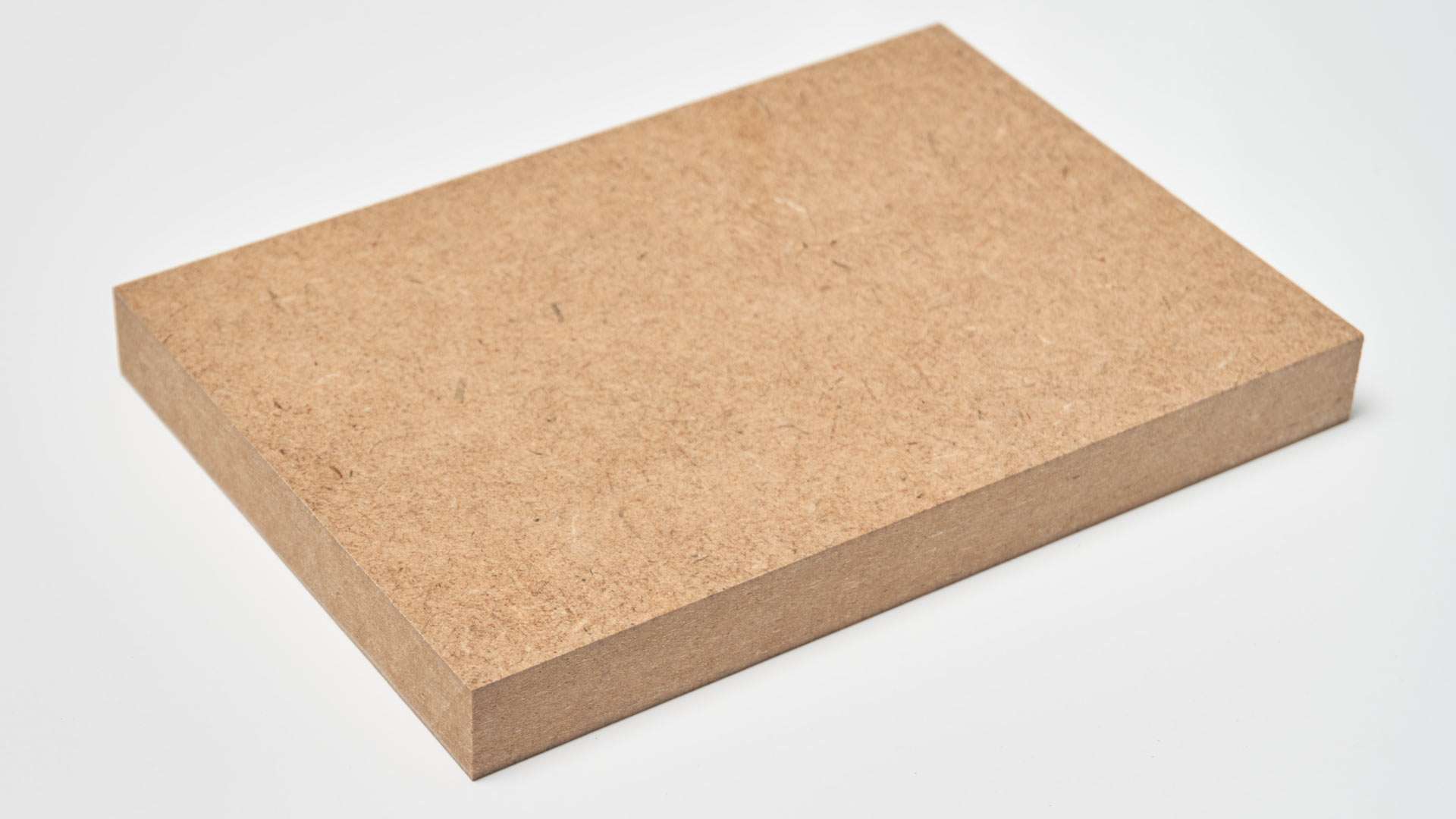
Moisture-resistant HDF (High-Density Fiberboard) is considered a “comprehensive upgrade” in the fiberboard material group. Its mechanical strength and structural stability are nearly on par with natural wood. Structurally, HDF is made from ultra-fine wood fibers, ground much finer than MDF. These fibers are then pressed under very high pressure and temperature to achieve a density of 850 kg/m³ or more. This superior density creates a dense structure with virtually no capillary gaps within the core. Combined with a high-quality adhesive that is resistant to moisture and heat, HDF forms a hard, heavy, and stable material, capable of meeting the most demanding requirements for high-end built-in furniture.
The outstanding advantage of HDF lies in its durable moisture resistance and superior hardness. Thanks to its tightly compressed ultra-fine fiber structure, HDF significantly reduces moisture absorption and swelling compared to conventional fiberboard. At the same time, its high hardness allows HDF to withstand impacts well, minimizes chipping at the edges, and maintains its shape throughout long-term use. When processed correctly, HDF surfaces are very flat and sharp, allowing for the finishing of intricate details. It is particularly suitable for designs requiring high precision and a solid feel when opening and closing cabinet doors.
Limitations of moisture-resistant HDF core in interior design applications
However, HDF’s high density is also a double-edged sword. Its heavy weight makes transportation and installation more complex, requiring specialized machinery and skilled craftsmen to ensure accuracy and safety. HDF is also more expensive than green core MDF, making it typically only chosen for projects requiring exceptional durability. Furthermore, not many furniture manufacturers use HDF according to proper technical standards. If the processing is not done correctly, the material’s advantages may not be fully realized.
In Bsmart’s material solutions system, moisture-resistant HDF wood core is often used for cabinet doors and cabinet systems requiring high durability and impact resistance. It’s also suitable for luxurious spaces such as high-end townhouses and villas. This is the choice for customers who prioritize sturdiness, long-term stability, and a sense of solidity in every detail. Where material quality becomes a statement of the class of the living space.
Moisture-resistant green core MFC wood – A flexible and economical solution for Bsmart Wall-Integrated Furniture

Moisture-resistant green core MFC wood panels are a popular choice in the built-in furniture segment, prioritizing cost-effectiveness and construction speed. They are particularly suitable for dry spaces with minimal direct exposure to humidity. Structurally, MFC is made from medium- and small-sized natural wood chips, mixed with moisture-resistant glue and pressed into panels at a standard density.
The board surface is pre-coated with melamine at the factory. This enhances protection, resists minor scratches, and improves aesthetics without the need for additional surface coating later. The green core inside is an indicator of the moisture-resistant adhesive system, allowing MFC to have better moisture resistance than regular MFC, although it is still only average compared to green core MDF or plywood.
The biggest advantage of green core MFC lies in its low cost and flexibility in construction. Thanks to its pre-finished melamine surface, the production and installation process is quick and efficient, significantly shortening project completion time. The color palette and surface textures of MFC are also very diverse, ranging from natural wood grain and modern solid colors to easy-to-match neutral tones. This effectively meets the basic aesthetic needs of many living spaces. With a reasonable investment cost, green core MFC becomes the optimal solution for projects requiring budget control while still ensuring a neat and tidy overall interior design.
In terms of moisture resistance, green core MFC only offers a relatively good level
Due to its wood chip structure and relatively low compression density, this material is prone to swelling if exposed to water for extended periods or placed in areas with consistently high humidity. MFC also has more limited screw-holding capacity compared to MDF or plywood, especially when frequently disassembled or when hanging heavy doors. Careful consideration of the installation location and load is required.
In Bsmart’s solution system, green core MFC wood is often used for built-in cabinets in dry areas such as bedrooms, offices, or spaces not adjacent to damp walls. This is also a reasonable choice for customers who prioritize budget-saving solutions and quick construction, while still ensuring basic functionality and aesthetics for their living space.
Wood-plastic composite (WPC / PVC Foam Board) – A “waterproof” solution for harsh humidity conditions
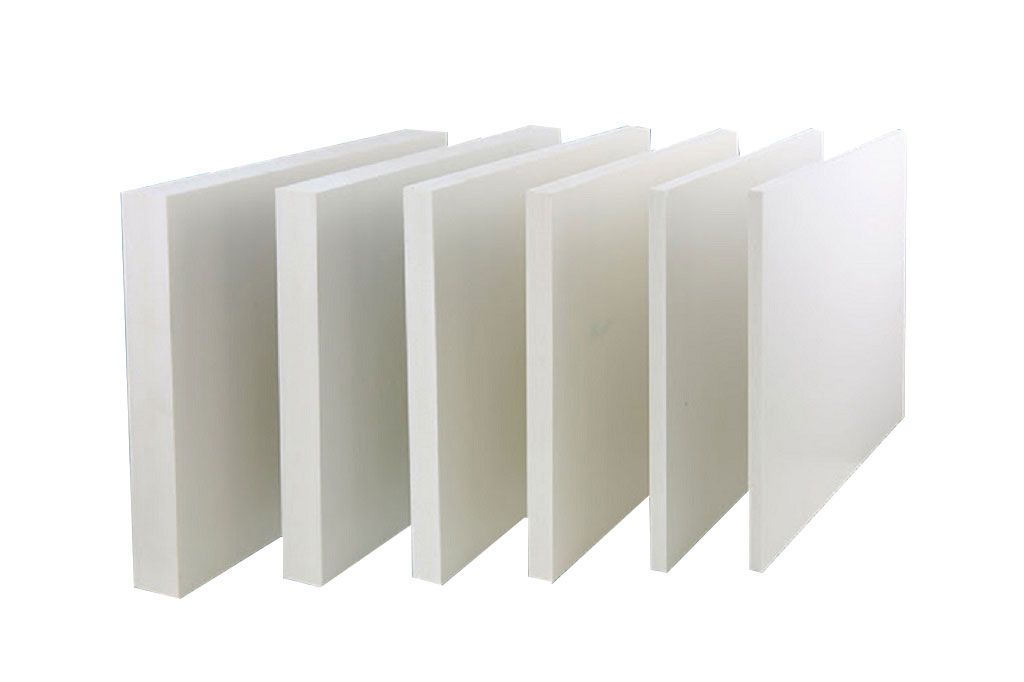
WPC (Wood Plastic Composite) or PVC Foam Board represents a completely different approach to built-in interior materials, where water resistance is the absolute priority. Unlike traditional engineered wood panels, WPC and PVC Foam Board are made from PVC plastic combined with wood powder or technical additives. This creates a homogeneous material that is waterproof and virtually unaffected by environmental humidity. This “non-wood” structure completely eliminates the risk of moisture absorption, the root cause of swelling, mold, or decay in prolonged hot and humid climates.
The most outstanding advantage of wood-plastic composite (WPC) is its almost absolute water resistance. Even when placed in frequently humid environments or in direct contact with water, the material maintains its stable shape, does not mold, is odorless, and is not attacked by termites. This is an advantage that no other type of engineered wood core can match. In addition, thanks to its plastic composition, WPC and PVC Foam Board have mild chemical resistance and are easy to clean. They are particularly suitable for areas requiring high levels of cleanliness and safety.
Limitations to note regarding wood-plastic composite materials
However, its structural characteristics also create certain limitations. The hardness and load-bearing capacity of WPC (Wood Plastic Composite) core are not as high as Plywood or HDF. Making it less suitable for heavy load-bearing applications or hanging heavy doors. Aesthetically, despite improvements in surface technology, the natural “wood” feel of WPC and PVC Foam Board still lacks the sophistication of high-end engineered wood panels. Furthermore, the investment cost becomes quite high if using a wood-plastic composite core for a large cabinet system, making this solution difficult to optimize from a budget perspective.
At Bsmart, WPC/PVC Foam Board is typically used selectively, focusing on particularly humid areas such as lower kitchen cabinets, areas near bathrooms, or locations with a high risk of water exposure. Combining WPC with other wood cores like plywood or green core MDF maximizes its water-resistant properties while maintaining aesthetics, strength, and cost-effectiveness for built-in furniture.
>> See more: Bsmart Interior Design and Construction Services.
3. How does Bsmart select the wood core for built-in furniture?
At Bsmart, the selection of wood for built-in furniture isn’t based on a rigid formula. Instead, it’s the result of a thorough analysis of the space, environmental conditions, and lifestyle habits of each family. Bsmart’s core principle is “the right area, the right function”. Because each space in the house has different humidity levels, load requirements, and aesthetic needs.
Instead of using a single type of wood for the entire structure. Bsmart proactively combines various materials to optimize long-term durability and practical efficiency. Durability is not judged at the time of handover. But rather by its stability after many years of operation in Vietnam’s characteristic hot and humid climate.
Suggestions for choosing wood core according to different family spaces
Specifically, for bedrooms – spaces requiring stability, high aesthetics, and a relatively dry environment. Bsmart prioritizes moisture-resistant green core MDF or high-quality green core MFC. This ensures a beautiful, smooth surface, ease of finishing, and reasonable cost. In the living room, where TV cabinets, display cabinets, and wall panels. Are both aesthetically pleasing and have a certain load-bearing capacity. The combination of green core MDF and Plywood in load-bearing areas creates a sense of sturdiness, durability, and sophistication.
For kitchen areas, especially base cabinets, which are frequently exposed to steam and high humidity. Bsmart prioritizes moisture-resistant plywood or a combination of wood-plastic. Composites in sensitive areas to minimize the risk of swelling and mold. For damp areas such as near bathrooms, low floors, or adjacent to exterior walls. The material solution will be upgraded to WPC or PVC Foam Board. This ensures water resistance and a long lifespan for the entire built-in furniture system.
>> See more: Bsmart’s method for selecting and arranging built-in furniture.
Conclude
In built-in furniture, there is no single wood core that is perfect for every location. Instead, there’s the most suitable option for each space and usage condition. Built-in wardrobes, kitchen cabinets, and decorative wall panels are all integral to the architecture, directly affected by humidity and time. Therefore, careful consideration is needed from the core. Bsmart selects wood cores based on climate, functionality. And budget, ensuring each product is not only beautiful upon completion but also durable for many years of use. If you are looking the optimal Bsmart Wall-Integrated Furniture for your Vietnamese home. Let the Bsmart team advise you in detail and provide the most suitable solution.
=====\
BSMART – SMART IN DETAILS
Website: https://bsmart.vn/vi/
Fanpage: https://www.facebook.com/bsmart.vn/
Hotline:
Hà Nội: 0853 388 668
Hồ Chí Minh: 0903 425 885
Showroom address:
Hà Nội: 230A Hoàng Ngân, Phường Trung Hòa, Quận Cầu Giấy, Hà Nội.
Hồ Chí Minh: 76 Bát Nàn, Phường Bình Trưng, Tp. Hồ Chí Minh.
#do_lien_tuong_bsmart_hien_dai; #do_lien_tuong_bsmart_thong_minh
#noi_that_do_lien_tuong_bsmart; #do_lien_tuong_bsmart
#fit_out